Progress And Promise
Top 3 Ways The United States Is Securing The Future Of Healthcare
The U.S. medical supply chain is undergoing a strategic transformation. The industry is prioritizing domestic manufacturing alongside a diversified blend of nearshore and global sourcing. This shift is a direct response to global supply chain challenges and is heavily influenced by current U.S. trade and tariff policies. These policies simultaneously motivate domestic production while creating complex new cost hurdles.
Manufacturing Is Moving Home
The momentum to strengthen U.S.-based production is rapidly growing. Recent announcements prove this shift is already underway, with a portion of critical medical products being made in the USA.
Industry leaders aren’t slowing down. A HIDA 2025 survey highlights strong plans for expansion: 52% of manufacturers plan to expand their domestic footprint within two years, and 67% expect increased domestic manufacturing over the next five.
Overcoming Costly Roadblocks
While the ambition for U.S. production is high, there are still significant obstacles that strain domestic manufacturers:
- Raw Material Scarcity: Access to medical-grade raw materials is often limited, creating a bottleneck for production.
- Punitive Tariffs: Key components and inputs often sourced from overseas are subject to multiple tariffs (such as Section 232 and IEEPA). These tariffs dramatically increase costs on materials that frequently lack domestic alternatives, putting a financial squeeze on U.S. producers.
Shifting To Positive Incentives
To truly unlock the potential of domestic manufacturing, the U.S. needs to shift its strategy. Instead of relying on punitive tariffs, the focus must be on providing positive government incentives to foster sustainable, long-term growth.
Domestic Manufacturing Makes Headlines In 2025
Medical manufacturers have made new investments in domestic production this year, creating jobs and building resiliency into the medical supply chain.
- January 2025: BD announced plans for more than $30 million in investments in 2025 to expand manufacturing capacity for IV lines at its plant in Utah to support continued growth in catheter solutions.
- May 2025: Siemens Healthineers announced that it will relocate manufacturing operations for radiotherapy systems for its Varian subsidiary from Baja, Mexico to Palo Alto, CA, adding approximately 50 new U.S. manufacturing jobs.
- August 2025: Thermo Fisher launched a 375,000-square-foot manufacturing facility in Mebane, North Carolina. The site's high-speed automation enables the production of 96 pipette tips every 12 seconds, culminating in 5,000 assemblies per hour. The expanded facility is expected to create 100 new jobs.
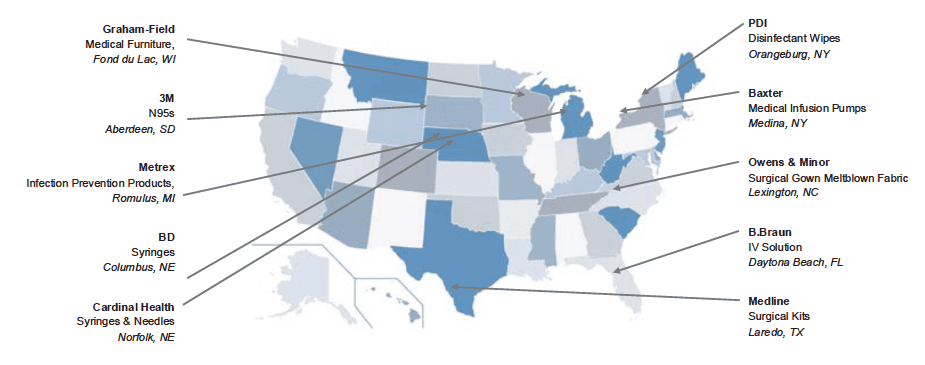
Manufacturing Across America
For this map, HIDA members were asked to submit one of their domestic manufacturing locations to provide a representative sample of manufacturing across America.
U.S. Medical Manufacturing Grows As Industry Exits China
Since August 2024, HIDA has surveyed our members on a regular basis to assess the state of the global medical supply chain, and spot key trends in domestic manufacturing.
98% Of Medical Manufacturers See Medical Manufacturing Exiting China
Over The Next Five Years, 67% Of Medical Manufacturers Expect An Increase In Domestic Manufacturing
Manufacturers plan multiple strategies to expand, including expanding production lines at existing facilities, building or acquiring a new plant, reshoring an existing manufacturing line, or creating a new product.
52% Of Manufacturers Had Plans To Expand Their Manufacturing Footprint In The United States In The Next Two Years
However, domestic medical manufacturing exists within a global supply chain. Domestic manufacturers rely on global partners to supply inputs such as raw materials and key components.
Only 2% Of Medical Manufacturers Source All Of Their Raw Materials From Domestic Sources